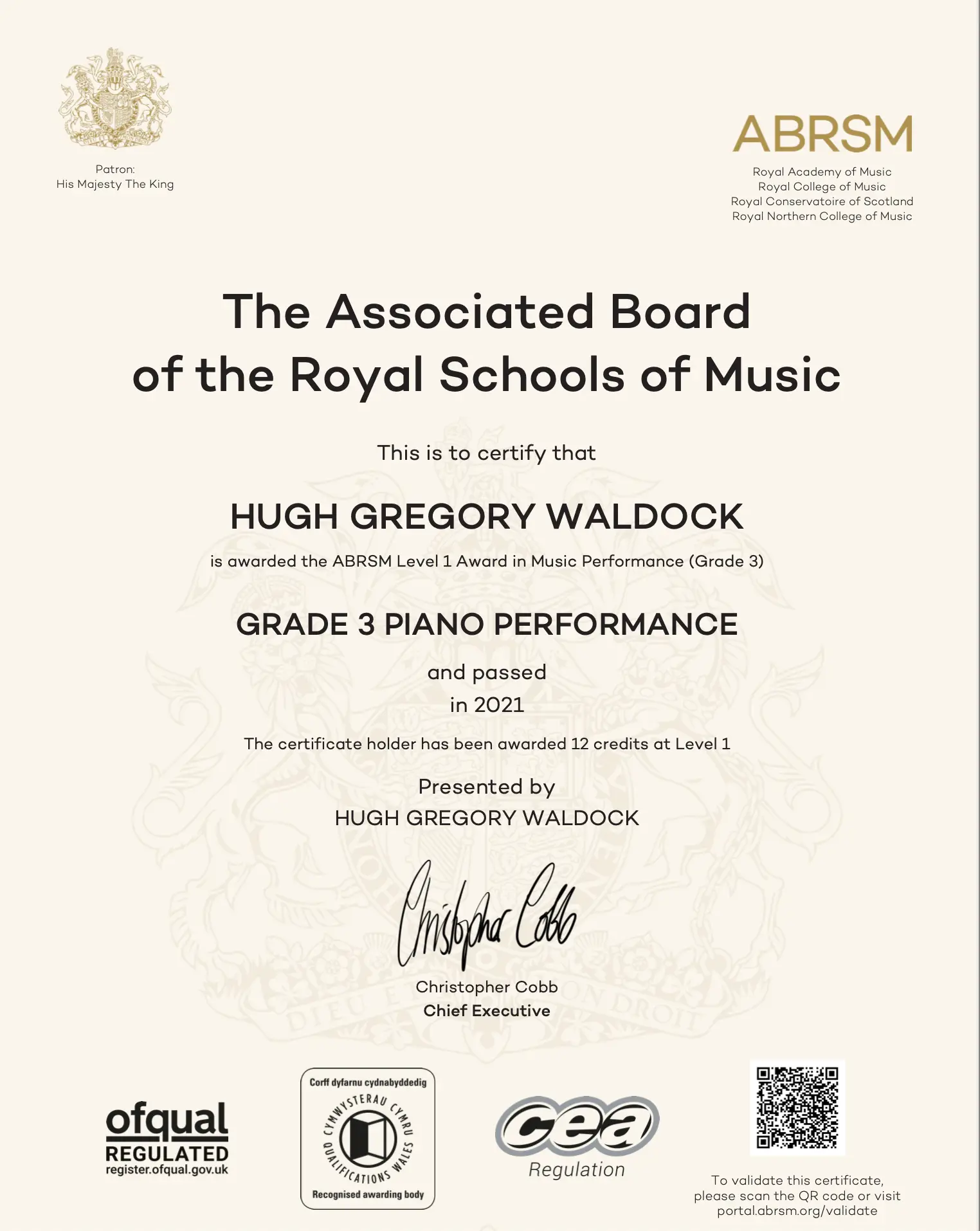
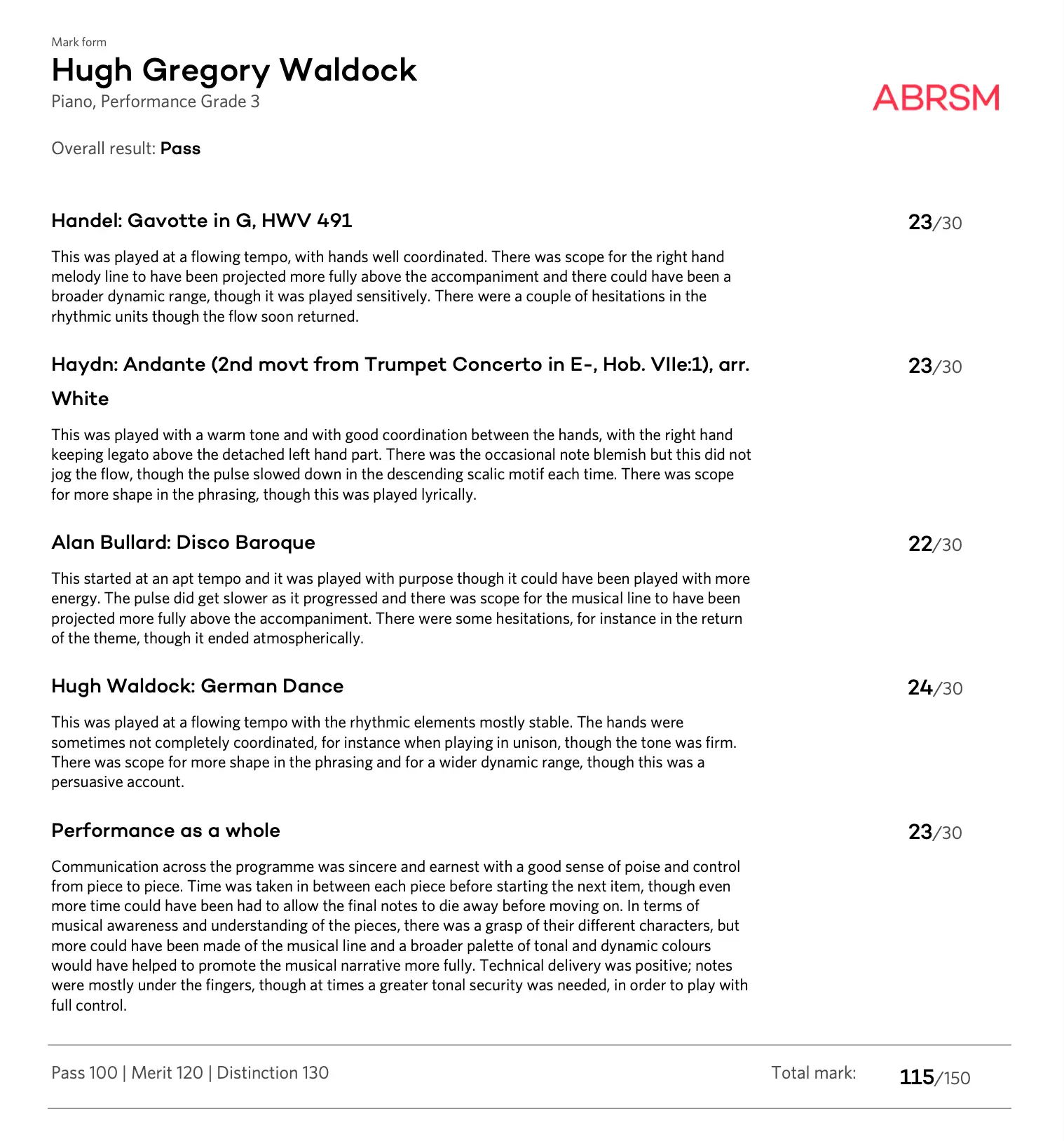
My first few very nervous steps on piano
My piano story started late in 1995. I didn't play in childhood. In fact, I couldn't play a note before my 16th birthday. It was decided that I would have a piano teacher to help me with my harmony at Ipswich School in Suffolk in England.
The Jenny Lawford era
My first lessons took place at school with Trinity College London graduate Jenny Lawford. It wasn't very promising at first. I was told to give up because I found it hard just to play both hands in contrary motion five fingers up and down and play little pieces with both hands going independently. It took me six months to master my first piece German Dance by Michael Praetorius. She chose the Classics to Moderns Book 1 textbook for me. I still play some form there and record them.
Enter Judith Inge : Grade 2 and Junior Competition Success
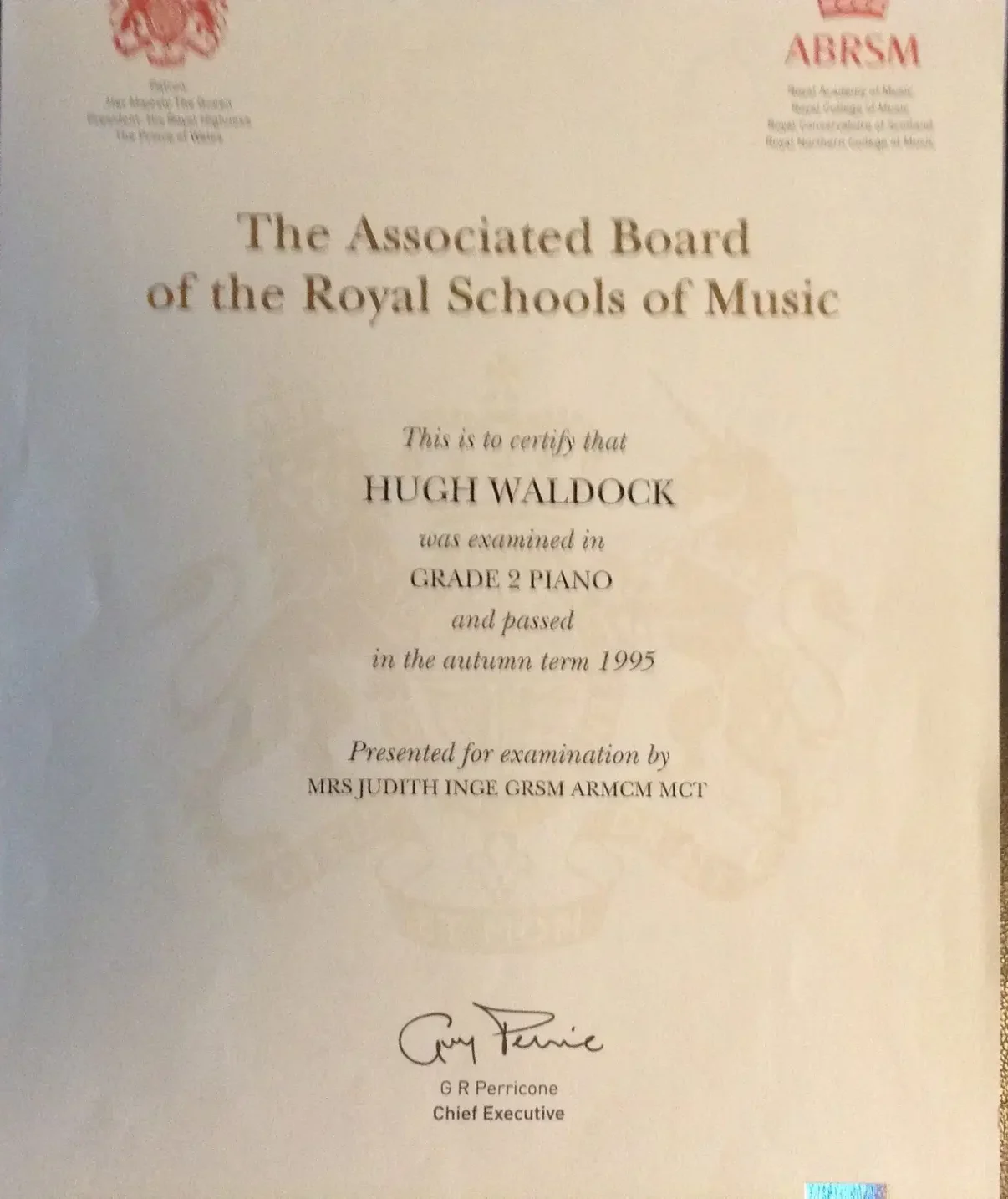
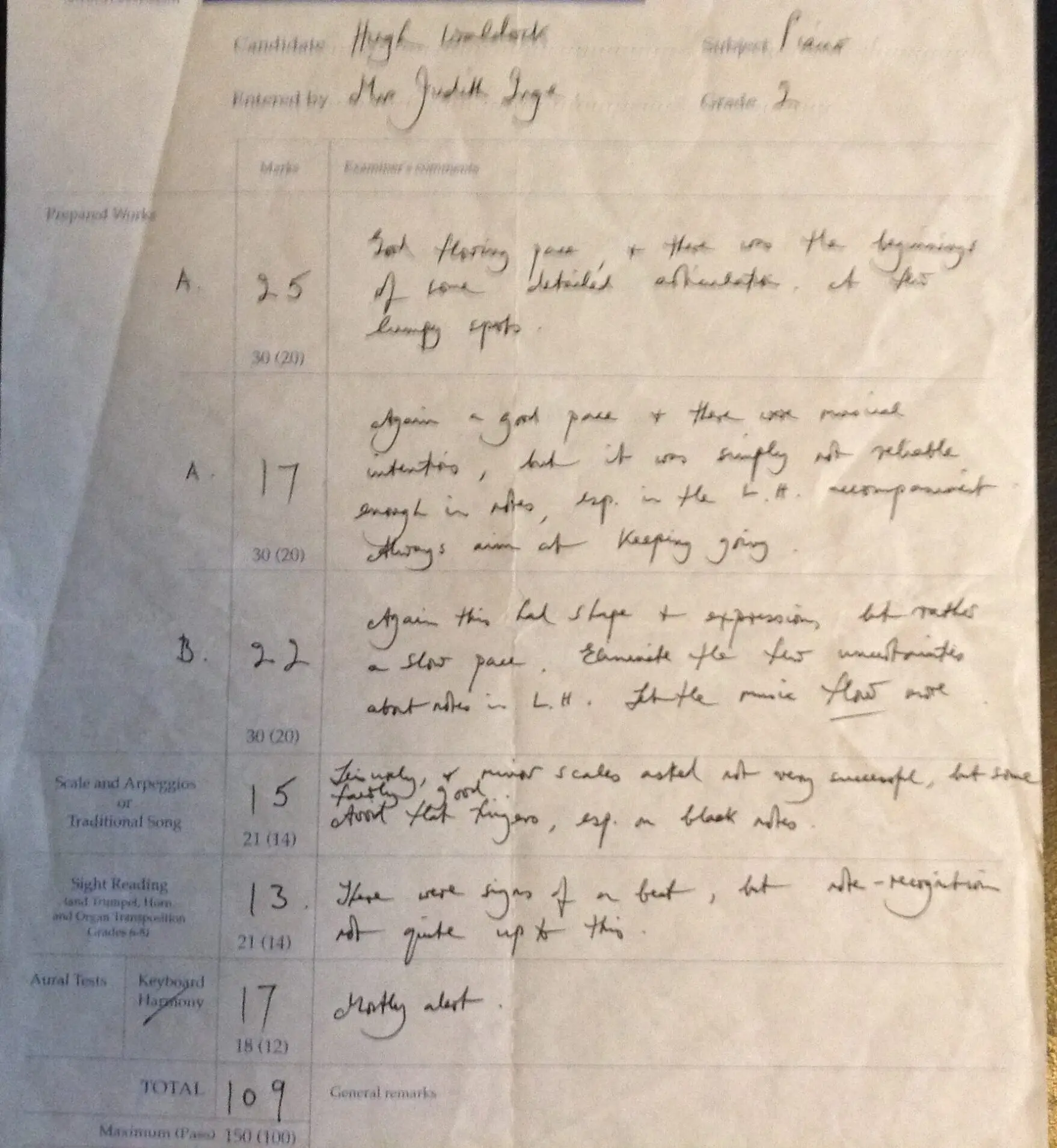
Judith Inge was my second RNCM educated piano teacher from the Royal Northern College of Music in Manchester. She was a really nice woman. She got my some interesting music including my book of Waltzes which I still treasure and some light hearted compilation called the Joy of Piano Entertainment. I just about scraped Grade 2 ABRSM with 109 pts in 1995 and that was my last grade for a while after school.
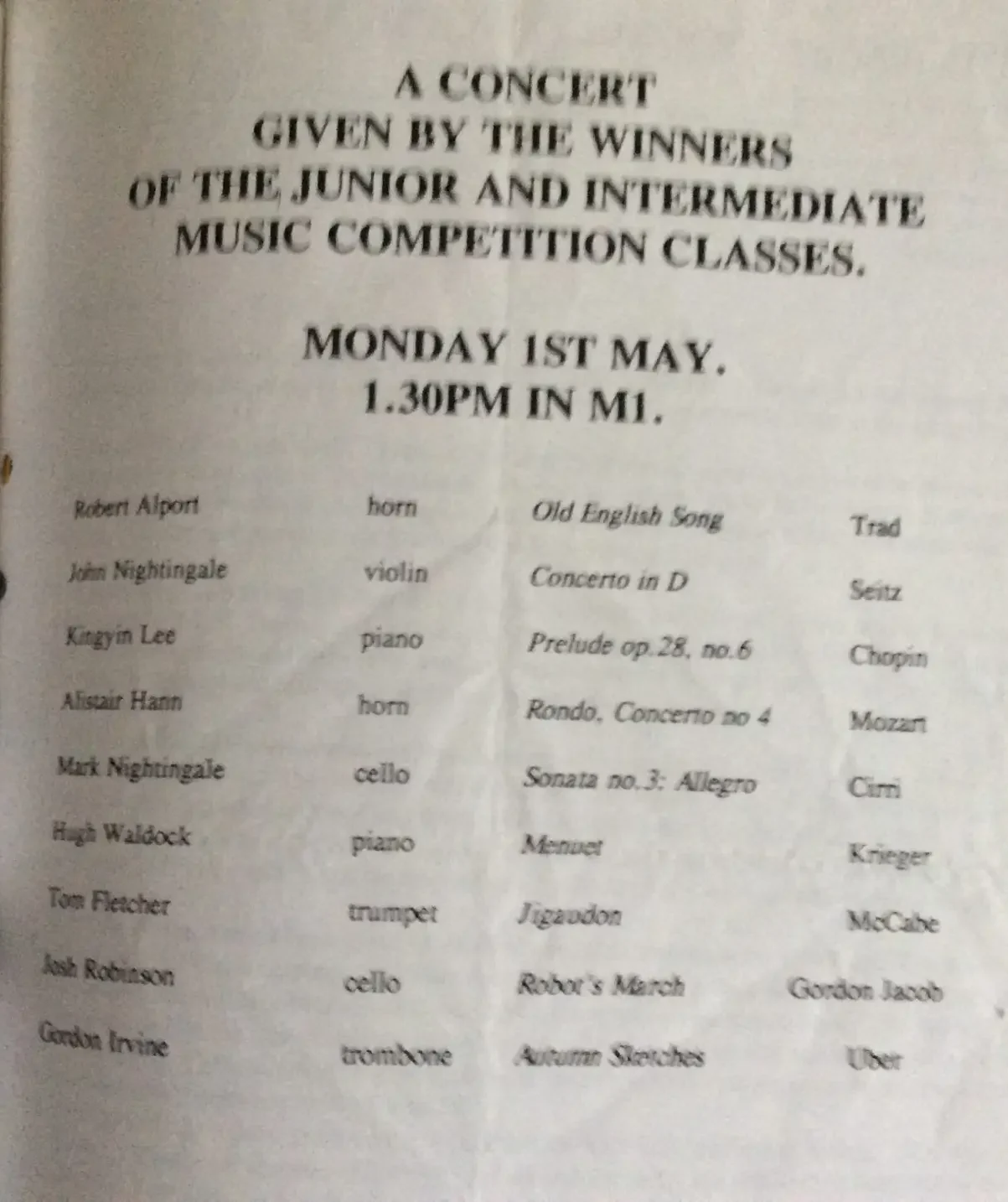
I was also very lucky to win the school junior competition a day after I won the school singing cup at senior level. There were only 2 entries and he tried to play bohemian rhapsody but made a catastrophic amount of mistakes and I won by default even though I only played a Johann Krieger Minuet in A with one mistake in. Judith said I was very charismatic when I played it though and it sounded good. I played it with ornamentation she devised for me. I felt very lucky indeed to get that third school title but I admit to not having been technically advanced at the time. He should have chosen his piece better. It was a dead cert if he hadn't tried to blow me away I was shrapnel at playing at that stage. I still consider it a bit of a booby prize for wining the singing. that win really has helped my playing though long term as I never though I'd win a piano competition starting at 17, and I've never taken my playing seriously ever since which has helped at crucial times. I now enjoy playing every bit as much as singing.
After the Break : Cologne Conservatoire Wuppertal Campus 2002 - 2004 Second Study Course and Exam with Jan Ehnes
After a few years of uncertainty about what I was going to do with my life, I had tried several things out; Christmas Postal Worker my first ever paid job sorting for Royal Mail, Operations Assistant in Boots the Chemist i/c stock replenishment and date checking, and a spell as a Telesales agent for AXA Direct motor and home insurance, but finally decided to try working abroad in Europe where there were opportunities for EOSL tutors at the time. I trained to do that initially.
When I arrived in Europe, I joined a traditional German Bach Choir in the city of Kassel where I was working at the time, sang the St Matthew Passion with them and got a voice teacher out of it in Alexander Stevenson the American Hero Tenor. Indeed I started to train with him at his house in Brasselsberg. He got me into conservatoire in Germany in the post industrial textile city of Wuppertal in North Rhein Westphalia in the West of Germany in 2002 where I studied until 2005. during which time I was given compulsory second study piano lessons with Jan Ehnes which I'm pleased and proud to say I passed.
A Great Teacher : Cometh the hour cometh the Jan!
Jan Ehnes was the best music teacher I ever had. He was the brother or half brother of violin legend James Ehnes. He was only allowed to teach me as a second study. So it's remarkable that he has that reputation with me. It's just that he had such an understanding of me personally and my strengths and weaknesses. He was so unlucky and so underrated because they chose his brother as a world star. He was like Prince Harry to me. he was always seen as the spare as well, but he is such a clever pianist. If I play the above again I'll play it even better I'm sure.
He hardly ever makes a mistake, in fact I've never noticed him make one. He has an immaculate clean lined Finnish piano technique and he does play with passion. He also has a background in the military, so he really knew how to get it out of male underdogs like me that are perhaps accused of being a bit lazy. He was also capable of understanding and compassion for my illnesses. He instilled it in my to really practise for my final exam. In spite of a very shaky start in a class I had no right to pass with my background in piano he got me a C- in second study piano from a top German conservatoire. That is totally unreal because I fully admit I totally lacked confidence at it and I was crap. Form that position of being a bit of a character he alone made me into a serious musical contender. Mr Stevenson my voice teacher encouraged me to be innovative and contributed that, but he got me the musical skills to be a musician if Stevenson got me the voice Jan got me the musicianship it can be learned. A lot of people think it's impossible but he did teach me the psychology to win by playing a piece with zero defects and he said that's all you have to do in the sense that a golf pro is a pro because he has a handicap of zero it was kinda his thing to play without a single defect. He got me to win a perfect performance and playing of a piece of music (and later it happened with my voice as well singing baritone) simply by no longer tolerating any mistakes in my work. Most teachers in my country aren't that brave they are too accepting of ambiguity in their pupil's playing and the never gain the joy and sensation of that immaculate performance and sense that any piece however hard, is ultimately playable if you can but unlock that level in your playing even by yourself. When I first playing really well later on I played Für Elise by Beethoven and it's started to play itself I wasn't thinking about what I was doing I was in this alpha state with the feeling of electricity like Billy Elliot no long actively playing me work but listening to it. It that feeling of being in harmony and at one with oneself that he imparted. If you feel you can't play it play it anyway innovate a solution per aspera ad astra. Hugh, you are the worst pianist I've ever seen he said but if you really want to play Bach Prelude BWV 902a at Grade 6 in your exam you CAN do it! They say you can't; just play it anyway! Saying that really worked with me. It's just you and the keys; you let your hands and fingers do the talking; everything else is just hot air!
The second study piano exam itself took place in the winter term of 2004 when I was 25 and consisted of the following pieces:
Exam programme (20 minutes) Grade 3.5 (C-)
Children's Pieces from the Hungarian Piano Method Book II 1967
1. Manakin by Dimitri Kabalevsky
2. Little Fairy Tale by Dimitry Kabalevsky
3.Two Hungarian Dances by Ferenc Farkas
4. Gavotte by Georg Friedrich Telemann
5. A Polish Polka dance
6. Accompanying Soprano Eva Trümmer singing the Moon is Risen a German folk song by Scholtz
The centrepieces were 2 Bach Preludes from Little Preludes and Fugues.
7. Little Prelude in C BWV 939
8. Little Prelude in G BWV 902a
This is my version of it from a few years ago I can probably do it better than that now it's worth another go I think. Sweet little prelude isn't it he wrote these and the inventions for the education of his family members. So we we were initiated into playing as if we were his offspring in my German college. Bach was compulsory.
It's the first half of this piece. It's so beautiful it makes me cry every time I lift the lid. I so wanted to play it for my ex who is a Soloist for the Bach Church in Leipzig where he worked. I did bring it off nice and slow! playing that changed my life because I thought it was impossible and it isn't if you work that hard at it. I must record it again myself sometime with the Fugue its around ABRSM Grade 6. It's had an amazing effect on my I believe nothing is impossible in terms of skill having conquered this wonderful piece of music. That is so hard most people wouldn't even try at age 25 for the first time with just 3.5 years lessons on the clock. I did do it! I played it live in the exam.
I need to learn that one up and record it again Here's a bit of Bach I played earlier; Minuet II from Bach Suite in C Minor BWV 813. This is one of my best recordings of my playing.
I left my course at Wuppertal conservatoire early and checked out with my study credits to change tactics and become a composer. I wanted to study more theory and musicology as a principle subject at Cologne University in 2005, but I got my piano exam from them! I just felt I wasn't a countertenor and I wasn't allowed to change to Baritone that I sing now so I left with dignity by mutual agreement. I got six theory and musicology papers and the piano exam. I really enjoyed my time there. the theory was good there with Professors Petra Obenaus and Lutz-Werner Hesse who was himself a very accomplished composer. He wrote a concerto for Chinese Zither and orchestra that was premiered by the Wuppertaler Symphonia in the Stadthalle Wuppertal in 2004 and I got free tickets to see. We went through a complete overview of music history from Ancient Greece to the present and that was accompanied by a compete history of the development of tonality in music which was fascinating. Getting good at the keyboard instrument was like being reborn in a different musical language and generated an explosion of fascination surround playing.
We also studied musical dictation which was very useful for composing. A friend of mine Karolina Brachmann with perfect pitch, a Polish soprano that gave me extra paid classes 121 in aural training. She had some excellent communist era materials from her home country of Poland that trained fantastic aural skills of clapping rhythms from beginner level crotchets to advanced paradiddles and 2 part contrapuntal and 4 part chorale dictation the same. I've never seen those books here they were form the Sczymanowski School of Music in Torun. They helped get my a C at that I was useless at it at first. They say you can't teach aural skills but they found a way, clever race aren't they? The printed pages looked like 1980s school bog roll because they had no money but fantastic skills. Studying production also helped my aural sensitivity no end. We did a bit of Movement and Dr Hesse's music appreciation class which was truly fascinating with him taking us through his collection of rare music and recordings that influenced his composing. We also had Early music seminar with world expert Barbara Schlick who was nominated for a classical Grammy in 2022. A genius departmental head. My voice teacher was Alexander Stevenson who should now be proud of me for finally passing as a baritone and Jan Ehnes accompanied our song class also. We did a lot of Schumann and Schubert with our resident Korean tenors which has helped me prepare for my current exam. How I got so good at music theory was that Professors Hesse and Obenaus studied New England Conservatoire in Boston, US as well as in Germany, so I've learned theory from three western traditions the London based ABRSM, the American way and the German method. What they had to say was pretty useful too!
In addition to my singing. It happened really late with me when I returned to the UK in 2010 at 29 years of age only then did I really start to practise and take off with composing and playing there having not seen very much for me to do professionally in my home city of colchester I turned to using the time to improve skills alone.

The Homecoming
From 2007-2009 I was busy elsewhere completing my professional academic interest in Teaching English as a second Language. Between 2003 and 2007 I'd practised that professionally to earn regular income to finance studying music in Germany. In Cologne I had a linguistically gifted girlfriend from Eastern Europe who wanted to work as an English teacher like I was doing and spoke 6 foreign languages to at least C1 level. For a while that side of my life took over as I met her doing one of my subsidiary subjects in the English Seminar of the University of Cologne in a lecture with Oxford educated Heinz Antor on the Loss of Centre in the 20th Century English novel that was particularly good. We covered Brideshead Revisited and Decline and Fall, Brave New World and so on. She liked me and made me sit next to her then generated sympathy by claiming she had RSI in her hand and could I write notes on the lecture for her. I didn't do piano with her but we taught together at the Kids Camp Carpe Diem Kids in Cologne Widderdorf for Professor Juliane Mörsdorf Schulte who asked me to do the English for her and her the embroidery and language history classes. She could do wonderful Russian embroidery that they loved her for. She was Belarusian and is now a German citizen. So I got into my German and English classes or my subsidiaries rather than doing tons of musicology per se. One very sweet young doctor called Jessica taught me syntax and morphology of modern German and with that one excellent lecture I was able to boost my income translating professionally so I started to orientate my life around linguistics. Part of that was completing a 2 year MA in English for Specific Occupational and Academic Purposes or custom designing language classes according to student needs. when I came back and split up from her I did that.
Whilst studying for that I joined the European, German and Classical Music Societies at Essex. I was secretary of the German society but we only had 3 members and three of us were on the board, because most of the Germans were persuaded by the German Attache's daughter to join the European Soc. The classical music society was really lively; they employed Steven Evans to do an orchestra with us a world class concert pianist that's how having 2 masterclasses with him in piano got me into practising again. I did a concert for them in the theatre and played my prelude BWV 902a by Bach again. I drove all the linguist by doing 5 hr practices in the piano room next to the language school. Jan had taught me well. I was learning some new pieces alone for a house concert for my family.
My House Concert 2010
The little programme I learned for that by myself with no help was as follows:
1. Erste Verlust by Robert Schumann
2. Sonatina in C by Muzio Clementi Op.36 Nr.1 (1st video below)
3. Prelude in C from the Well Tempered Clavier BWV 847 by J.S.Bach (2nd video below)
4. Waltz Op.179 Nr.21 by Cornelius Gurlitt
5. The Cuckoo Rondo by Louis-Claude Daquin (1st video above)
6. Rondo from Sonata Facile by Wolfgang Amadeus Mozart K.545 (2nd video above)
7. Für Elise by Ludwig von Beethoven
I performed that porgramme for my extended family mum my two aunties and cousins in 2009.