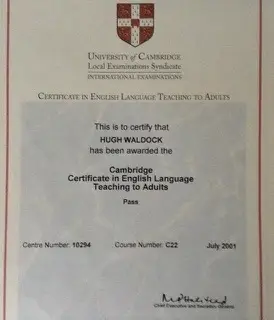
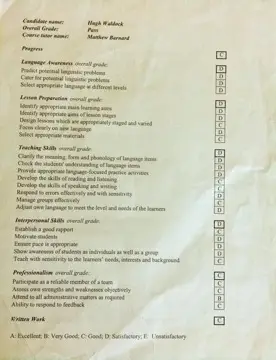
1.0 CELTA: International House London
1.1 The Fabulous CELTA Fives.
Thinking a year further back to the millennium in 2000, I was considering how to achieve my aim in some way, of seeing the world and earning some money at the same time. One easy way of doing that was to take an English Language Teaching course and then get a job abroad as an English Teacher to Adults.
In 2000, roughly one third of the jobs were for people without degrees, holding a so-called CELTA or Cambridge Certificate in Teaching English Language to Adults. This information was provided by a little book called Talk Your Way Around the World. The course cost about £1,000 to get the initial qualification.
In order to be certain that it was what I wanted to do, and I wasn’t wasting money, I decided to do the A Taste of Teaching English as a Foreign Language course offered at International House Language School, 106 Piccadilly, in London, precisely for CELTA candidates such as myself, in the summer of that year. It was there that I had my first real taste of truly exceptional language teaching.27I’d been used to the standard language GCSE and A level taught by a prominent essay-writing academic armed with a degree, who insisted on over-using vocabulary lists that were repeated with the regular, demotivating monotony of a hamster on treadmill, and language going in one ear and out the other because it simply didn’t work for my learner type.
During my first demonstration lesson in Serbo-Croat at IH London, however, I found that I could remember Jelim, sandwich se Sirom, molim simply with the lesson being demonstrated more effectively than at school. I never forgot that vocabulary item after just one 45-minute session. I was smitten with that instant achievement. Moreover, the teacher appeared unshackled, even happier in herself, having been allowed to follow the freedom of her own style. Suitably impressed with how liberating language teaching could be, I signed up for the full course in 2001.
IH London’s CELTA graduates went on to work at the British Council abroad; in places like North Africa and Syria.By July 2001, a month before the America trip (see America Illustrated), I had given my notice in at work and completed the pre-course task together with the diagnostics, thus proving myself ready to compete. Apparently, the course was originally called the CELTA Five; there having been five elements of assessment for successful completion.
The duration is one month with one theoretical essay of written work a week (four essays in total), assessed teaching practice which was taught in the afternoon, and three hours of theoretical input before lunch, together with other criteria. Lunch took place in the lovely basement café or at a restaurant in the nearby Shepherd Market, depending on budget and the size of one’s appetite. That was why at the end of the course the address list bore the name The Fabulous CELTA Fives so that we could keep in touch if we wanted.
1.2 Barnard and Lynch
The head tutor was called Matthew Barnard and his deputy; Brenda Lynch. Ma\hew Barnard was a former pupil of Liz Soars, the inventor of the Headway series of English Language Teaching textbooks, the most successful ELT series of all time. Quite a few textbook writers worked for IH London, like Mark Powell and Paul Emerson in Business English. It was a rather successful school. I remember watching a video of Liz Soars teaching and she was quite a scary sort of woman with a posh voice and an annoying habit of clicking her fingers at pupils in order to elicit answers very quickly. Brenda was such a nice and caring lady with a lot of experience. She worked for IH London for years.
1.3 Theory and Teaching Practice
As said above, the day was divided into two parts, theory and teaching practice. Theory was always in the morning and teaching practice in the afternoon, preceded by lunch in between.In the student café over lunch, I met a student who was a so-called true digital learner for the first time. A digital learner is a pupil who learns words from lists easily. He was studying hard for his FCE or Cambridge First Certificate in English which is based on learning the two thousand most common words in English. He had taken to this task literally and got hold of the two thousand most common words in the English language from the General Service List (1954) and was busy learning them all parrot-fashion in order to do well in his exam. If that seemed more than a little crazy, another mad moment at International House language school proved even more bizarre. A teacher had made a display with live maggots and earthworms for pupils to describe movement to the left or right.These worms were situated behind a pane of glass. Unfortunately, it had been too hot a day, for the worms to survive. They were dying in the display and the only thing pupils could describe about them was how they were shrivelling up in the heat which wasn’t part of the lesson plan.
1.4 The Pre-Course Homework
The purpose of the pre-course homework was to familiarise ourselves with the tenses in English and the basics of pragmatics and morphology, phonetics and phonology, and to learn chapters from a book called Learning Teaching by Jim Scrivener.
1.5 The Three Ps of Lesson Planning in Task-Based Learning
The three Ps of lesson planning are preparation, practice and production. Preparation consisted of a short demonstration and work on understanding the task; practice is carrying out the task itself; and production is producing a record of that task in some way. For example, you could ask pupils to think of a folk tale from their home country and make notes on it individually (as preparation). Students would discuss this as a class (practice), and then prepare a dramatic scene from their choice of folk tale, which they would then perform (production). They might receive a mark, comments, or language focus work, as feedback in order to help them improve.
One specialist type of feedback is language focus feedback or linguistic feedback, that focuses on structures and grammar; an example of this might be to listen in to what pupils are doing during a task, write down a list of ten linguistic errors they make and then write them on the board. When they’ve finished they might be given a chance to correct their own mistakes in class, or alternatively you could print them out as a worksheet for homework.
1.6 Gist Task, Main Task
This is the classic double exercise whereby one is presented with a gist task lasting about five minutes, and then this is followed up by an in-depth main task lasting about twenty minutes usually on the same theme. This helps with lesson planning. Headway is full of gist task, main task exercises. For example, for a beginner’s class a gist task might be reminding ourselves of the days of the week, checking through them with a partner. Then the main task might be discussing with them what you did on them last week and feeding back to the class. (Pair Work)
1.7 Grammar
1.7.1 TensesExplaining the tenses is particularly hard at first if you haven’t done it before at school. The rule of thumb is to keep it simple because you can talk yourself into a big hole trying to explain tenses to foreign students. All you have to remember are the rules.Present simple is a simple fact, or something permanent that began in the past and continues through the present e.g. Michael IS a sensational talent at football or - a repeated action - Michael plays football every day. It is also used for verbs for which there is no present continuous for example some senses like to taste and to smell. It tastes good not it is tasting good*. It smells good not it is smelling good*. Certain errors can be attributed more to the native tongues of particular races due to the grammar of their languages. For example, speakers of Hindi and Urdu might make the mistake Oh, no, it is smelling good, quite commonly. Teachers such as the excellent Michael Swan documented some of these common mistakes in his book Learner English. Some of these common errors were satirised - some would say in a patronising way - in the 1970s comedy series Mind Your Language, which was criticised as racist, but I learned that many students from other races couldn’t get enough of it and knew every episode.
1.7.2 Completion of the Verb and Adjuncts
A verb can take either just a subject, a subject and a direct object, or a subject, an indirect object and a direct object to make a complete sentence in English. In English, there are three possible completions of the verb depending on what they require to make the sentence grammatical. Dogs bark, is a subject and verb alone. Jenny loved me, has a subject, verb, and direct object. Jenny gave the dog the ball, contains a subject, verb, indirect object, and direct object. We learned all these variations as part of our theory class and then we put them into practice taking it in turn to teach refugees at our teaching practice session. As we weren’t yet qualified trainers this cost them a mere £15 administration fee for a one month course.
1.8 Jazzmin
On this course, I met a very nice young Swiss girl called Jazzmin who went off to teach at IH Madrid at the end of the course. As I took it on myself to arrange the end of course meal at the Italian restaurant in Shepherd Market just around the corner, she shared my meal with me without asking. Was that a little show of appreciation from a nice girl, that she wanted to share my tortellini? Then again, maybe not, maybe she just didn’t want to pay?
1.9 Bydgoszcz and Kassel
I got a place at IH Bydgoszcz in Poland after the holiday in America the next month. Unfortunately, they only went and changed their mind by pulling out at the last minute but it is why I got a coveted B grade for attending to administrational archives which is a really equivalent to good grade on that aspect of a level five course on a degree course from Cambridge University. After successfully completing the one-month training course, back then that meant you could start your career in English Language Teaching.